
We are hiring a Junior Analyst
We are seeking a talented and motivated Junior Analyst to join our team.
Title: Junior Analyst - Crypto Projects - Company: 22/7 GP (227.fund)
Location: Remote
Job Type: External Contractor
22/7 is a forward-thinking private investment fund specializing in web3 projects ready to shape the future of the Internet.
Our passion is identifying and supporting innovative blockchain projects with the potential for breakthrough growth.
We are seeking a talented and motivated Junior Analyst to join our team and contribute to the research and evaluation of promising crypto projects. As an Analyst, you will play a crucial role in identifying and assesing potential investment opportunities, leveraging a variety of online tools and data sources. This position offers a unique opportunity to gain hands-on experience in the innovative and rapidly-evolving crypto industry.
Responsibilities:
1. Research and Analysis
- Conduct in-depth research on various crypto projects using online tools such as social media platforms (Crypto Twitter, Discord) and on-chain data sources (Nansen, TokenTerminal, L2Beat) as well as AI tools.
- Evaluate project fundamentals, including team background, technology, adoption, tokenomics, and market positioning.
2. Project Funnel Creation and Documentation
- Develop and maintain a robust funnel of potential projects for consideration by the fund.
- Identify key metrics and criteria for project selection, ensuring alignment with the fund's investment strategy.
- Maintain detailed documentation of research findings, analyses, and project evaluations.
- Prepare reports and summaries for internal and external stakeholders.
3. Trend monitoring
- Stay informed about market trends, news, and developments within the crypto space.
- Monitor and analyze the performance of existing portfolio projects.
Qualifications:
- Strong interest and understanding of the cryptocurrency and blockchain industry.
- Familiarity with online tools and platforms commonly used in crypto research.
- Excellent analytical and critical thinking skills.
- Strong communication skills, both written and verbal.
- Ability to work independently, collaboratively and proactively.
- Detail-oriented with a high level of accuracy in work.
How to Apply:
If you are passionate about the crypto space and possess the skills and qualifications outlined above, we invite you to get in touch via our website 227.fund/contactus (check ‘talent’). Feel free to send us your CV and socials; or email at talent [at] 227 [dot] fund
In your application, please include 1) your CV and 2) provide a short summary of one contrarian view you hold on anything crypto related.
OpenServ - Reasoning as an Asset Class
From bigger models to better reasoning
The last two years of AI progress have followed one main axis: scale. More parameters, more context, more GPUs. The assumption was that better reasoning simply meant bigger models.

OpenServ’s Reasoning framework challenges that idea. Instead of letting models think out loud in unbounded natural language, it converts problems into compact, machine-readable reasoning graphs. A large model creates the graph once; a smaller, cheaper nano model executes it repeatedly.
In joint research with Coyotiv, this approach delivers up to 99% reasoning accuracy and 30–74x higher performance per dollar compared with standard prompting on benchmarks like AdvancedIF, GSM-Hard, and SCALE. In simple terms, structured reasoning lets smaller models match or exceed models one or two tiers larger. The paper calls this the “OpenServ Reasoning Parity Effect.”
For builders, it matters for two reasons:
Cost: reasoning turns into an operating expense you can optimize, not a tax you pay to whoever runs the biggest models.
Reliability: deterministic graphs drift less than open chain-of-thought, which becomes crucial once agents start moving real money or executing on-chain actions.
This is OpenServ’s first wedge: a model-agnostic reasoning engine that makes agents cheaper and more accurate, regardless of which frontier model wins.
An integrated stack, not another SDK
If this were just a clever prompting trick, it wouldn’t be defensible. Techniques like this spread too quickly.
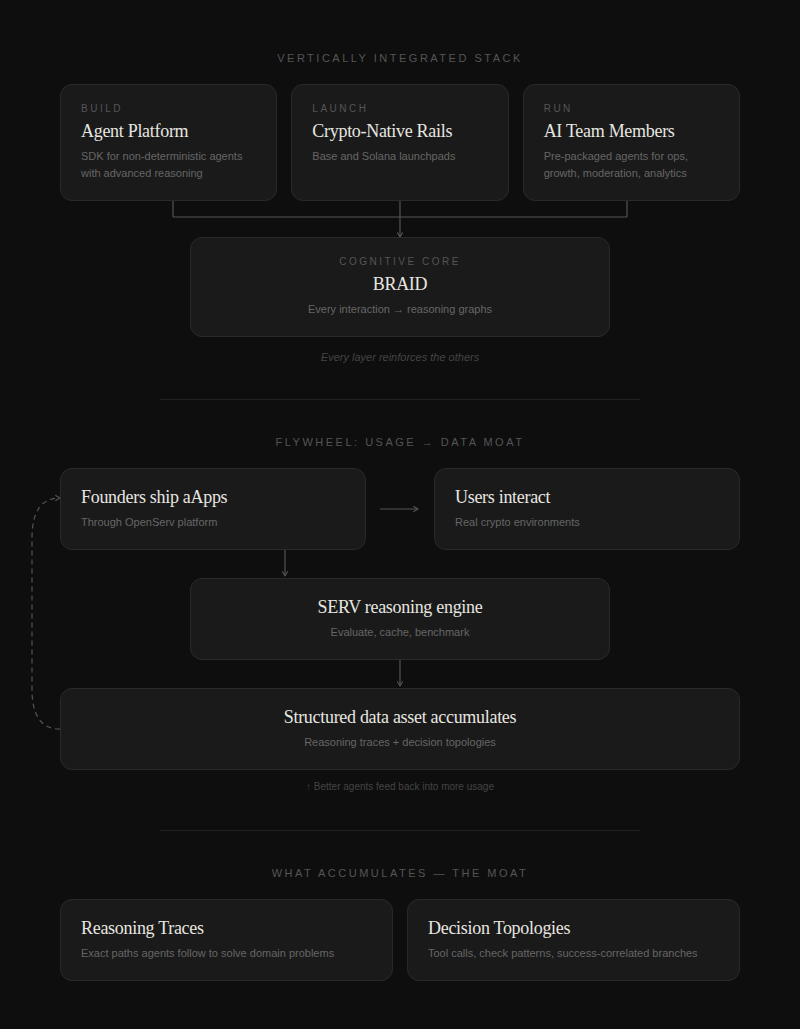
OpenServ is building a vertically integrated stack where its Reasoning framework sits at the cognitive core:
Build: An AI agent platform and SDK for spinning up non-deterministic agents with advanced reasoning, decision-making, and inter-agent collaboration.
Launch: Crypto-native rails for tokenizing projects, connecting to Base and Solana, and distributing agents through Telegram and other high-intent channels.
Run: Pre-packaged AI team members for operations, growth, moderation, and analytics running on the same reasoning engine.
Every layer reinforces the others. When a founder ships an aApp through OpenServ, every user interaction gets processed through its reasoning engine. Each request turns into reasoning graphs that are evaluated, cached, and benchmarked.
Over time, that builds a specific kind of data asset:
Beyond basic logs, the system captures structured reasoning traces that show the exact paths agents take to solve domain problems.
Instead of raw prompts, it records topologies: maps of tool calls, checks and balances, and the decision branches that correlate with successful outcomes.
This is the core of OpenServ’s moat. The depth and diversity of reasoning graphs generated by thousands of live agents operating in real crypto environments. That continuously expanding dataset is what makes OpenServ uniquely defensible.
Incentive alignment vs frontier labs
There’s a deeper strategic angle here: economic alignment.
Frontier labs make money selling tokens, literally the input and output tokens you consume through their APIs. More context, more calls, more “thinking” leads directly to higher revenue. Models that reason longer are great for their P&L, even if that isn’t optimal for users.
OpenServ flips that logic. The OpenServ Reasoning framework compresses reasoning into tight graphs, cutting token use dramatically while maintaining or even improving accuracy. Benchmarks show over 70% fewer tokens used and huge improvements in cost efficiency.
Two asymmetries fall out from this:
Frontier labs have little incentive to push methods that reduce their own token burn. They’ll improve reasoning, but it’ll still favor high utilization.
OpenServ is aligned with developers and users. Its pitch is simple: more correct actions per dollar, no matter which model does the underlying computation.
That makes it a natural second-layer partner, or acquisition target, for any lab that wants to demonstrate best-in-class reasoning without collapsing its own economics.
Where the moat sits
Defensibility shows up in combination and compounding.
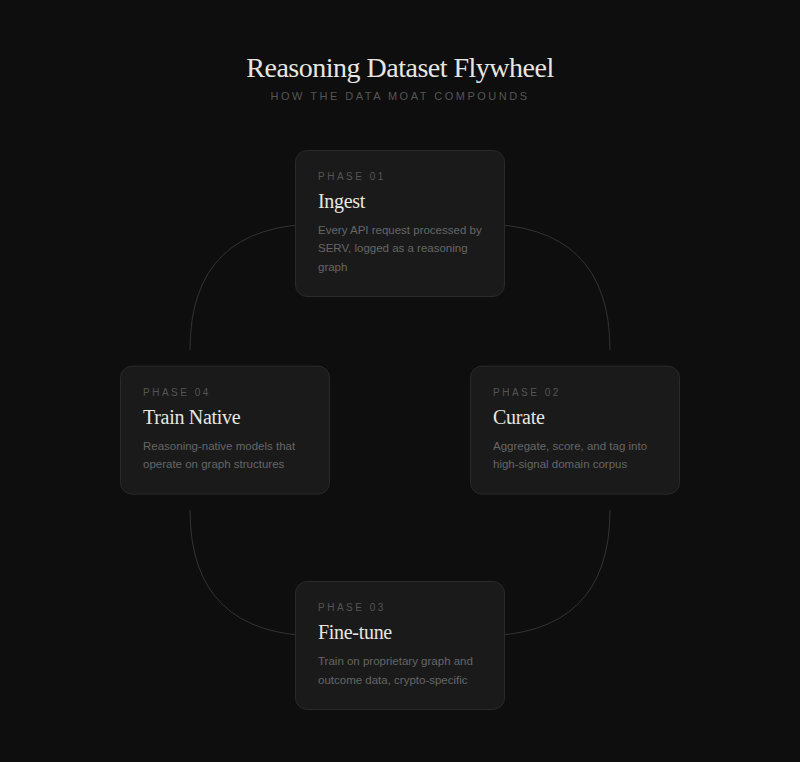
Reasoning dataset flywheel
Phase 1: Every request through the open API is processed by SERV and logged as a reasoning graph.
Phase 2: The system aggregates, scores, and tags these graphs. This creates a high‑signal corpus for specific domains and agent behaviors.
Phase 3: Fine‑tuning models on that proprietary dataset of graphs and outcomes, especially in crypto‑specific areas that the frontier labs tend to under‑serve.
Phase 4: Training reasoning‑native models from scratch that fully understand and operate on those graph structures.
Each stage builds on the last, increasing replication cost.
Positioning in the agentic and frontier model landscape
Zooming out, OpenServ sits right in the middle of the evolving agentic stack.
Below it are the frontier models pushing raw capability.
In the middle is the OpenServ Reasoning framework, turning unstructured prompts into structured reasoning graphs.
Above are agent frameworks and apps built by founders, from trading bots to community managers.
Around it lies the crypto infrastructure that these agents need to interact with: chains, wallets, DEXs, and social protocols.
Most players focus on one layer, either infrastructure or applications. OpenServ is deliberately full-stack, an AI co-founder for crypto spanning cognition, infra, tokenization, and go-to-market. It’s high variance, but if it works, that’s where most of the long-term value will concentrate.
Working thesis on OpenServ
Macro: The constraint for the next AI cycle isn’t raw IQ, it’s economically viable, auditable reasoning. Structured reasoning layers that sit on top of existing models will likely define the next major wave.
Tech: The OpenServ Reasoning framework quantifiably boosts performance per dollar, enabling smaller models to compete with or beat larger ones. Efficiency becomes a strategic resource.
Platform: By embedding OpenServ’s Reasoning within a crypto-native agent platform, OpenServ accumulates proprietary reasoning graphs and behavioral data that could power future reasoning-native models.
Token flywheel: The SERV token integrates payments, staking, and rewards. If agentic apps scale, SERV evolves into the economic spine of a new AI-crypto ecosystem.
Strategic optionality: As frontier labs recognize the economics of reasoning, acquiring a platform like OpenServ, with a proven reasoning engine, operating agents, and crypto distribution, becomes an obvious path forward.
Why this could look inevitable in hindsight
Five years from now, it may seem obvious that reasoning efficiency, not raw intelligence, was the layer where real value accrued. History tends to reward architectures that convert brute-force capability into leverage, just as cloud abstracted hardware and browsers abstracted operating systems. The OpenServ Reasoning framework does that for cognition.
If the economy of AI agents moves toward cost-sensitive workloads and auditable autonomy, OpenServ’s position looks almost predetermined. It converts unstructured token burn into structured, recomposable reasoning; and it ties that to a financial system that can fund, measure, and reward productive agents.
In hindsight, the idea that reasoning itself would become an investable layer will feel like it was the only logical outcome.
22/7 ♡ Marinade Finance

Marinade Finance has established itself as one of the premier staking solutions in the Solana ecosystem, combining deep technical innovation with accelerating institutional adoption.
Market Leadership Through Innovation
Staking is core to crypto infrastructure: it secures networks while generating yield for participants. Adoption is accelerating across ecosystems - more than 29% of ETH is staked, with two-thirds of that liquid; on Solana, over 76% of circulating supply is staked, with around 10% liquid staked.
Since launching the first liquid staking solution (mSOL) in 2021, Marinade has steadily evolved. Its flagship product today is the Stake Auction Marketplace (SAM) which routes stake via an open validator auction - a model akin to Google Ads bidding. According to Messari, roughly 65% of all staked SOL (267M SOL) flows through the SAM marketplace which, in our eyes, is a remarkable feat often overlooked by the market.
Native Non-Custodial Staking
Marinade Native (v2) is the only fully native, non-custodial staking solution on Solana, removing custody risks while giving institutions direct control of their SOL. Thanks to Solana’s unique architecture of separating withdrawal and stake authorities, Marinade enables funds, custodians and ETF issuers to stake directly while retaining full control of assets. This innovation has quickly gained traction: Marinade Native alone has surpassed $1B in total value locked (TVL), and across all products Marinade now commands more than $2.4bn in TVL.
Institutional Momentum
Institutional adoption is ramping. Marinade partnered with Bitwise for its Solana Staking ETP, and in May 2025, Canary filed for the first U.S. Solana ETF with staking via Marinade Finance. These partnerships strongly position Marinade as the default choice for ETF-based SOL staking.
DAO and Tokenomics Overhaul
Until recently, $MNDE functioned primarily as a governance token, that changed however with proposals MIP-11 and MIP-13 where following proposals got accepted by the DAO.
50% of protocol fees are now used to buy back $MNDE on the open market (since Sept 2025).
30% of supply (~$40M) was permanently burned to reduce FDV overhang.
These changes transformed $MNDE into a token aligned with both “revenue” and “ETF” narratives, creating a powerful flywheel where ETF adoption directly drives buy pressure on the token.
Valuation Gap vs. Competitors
According to DefiLlama, Marinade is already outperforming Jito on revenue despite managing less TVL. Marinade currently generates revneues of $13M per year versus Jito’s $12M, a sign of greater efficiency and stronger monetization of its stake flows. This is a meaningful signal because it shows Marinade can compete head-to-head with the market leader on fundamentals, even before accounting for its accelerating institutional adoption and innovations like Marinade Native.
Even more striking is the valuation gap between the two. Jito commands a fully diluted valuation of $1.8B, while Marinade sits at just $114M. Relative to TVL, Jito trades at a 0.53 FDV/TVL ratio, compared with Marinade’s 0.05 more than a 10x difference. In other words, Marinade is producing equal or greater revenue at a fraction of the valuation. For investors, this represents a rare asymmetric bet: if the market begins to price Marinade in line with peers, the upside could be significant.
Why We Invested
We see Marinade as a rare asymmetric bet on the Solana ecosystem. In our view, all the right ingredients are coming together making Marinade one of the most compelling opportunities in the Solana ecosystem today.
Talented OG team with a track record of execution.
Superior technology, from SAM to non-custodial staking.
Accelerating institutional adoption, with ETF and ETP integrations.
Objectively undervalued tokenomics, with buybacks, burns, and catalysts like Solana ETFs and the upcoming Firedancer upgrade.
IX Swap ($IXS): Revolutionizing RWA Trading in the DeFi Space

In the ever-evolving world of DeFi, IX Swap ($IXS) is making waves as a go-to platform for trading Real World Asset (RWA) tokens. Dubbed the "Uniswap for RWAs," IX Swap is poised to bridge the gap between traditional assets and the crypto world.
IX Swap boasts a strong regulatory foundation, with licenses in Singapore and the Bahamas. The project has garnered support from heavyweight investors, including Coinbase.
In 2023 IX Swap was acquired by InvestaX, a Singapore-licensed tokenization Software-as-a-Service (SaaS) solution. InvestaX recently became the first licensed RWA tokenization platform built on Coinbase’s blockchain, Base. These events have expanded IX Swap's product portfolio and paved the way for IX Swap’s integration with the Coinbase wallet, further enhancing the product’s accessibility and utility.
IX Swap is not just about trading; it's about democratizing access to real-world assets. The platform offers a launchpad allowing investments as low as $1, making it accessible to a wide range of investors.
Additionally, IX Swap plans to introduce staking with attractive benefits, including RWA token airdrops.
$IXS Token
The $IXS token, with a total supply of 180 million and 167 million in circulation, is designed with deflationary mechanics.
These are main features of the $IXS token:
The token is deflationary courtesy of the use of buyback/burns from fees
Holders receive discounted fees by paying with IXS
Staking rewards
Governance/LP rewards coming soon
Investment Potential
At 22/7 we firmly believe in IX Swap's potential and are holders of $IXS.
With actual licences in hand enabling tangible access to liquidity, IX Swap has first-mover advantage in the secondary trading of RWA token.
On the potential, IX Swap is positioned to create fully legal and compliant liquidity pool for a fresh wave of RWA tokens. Moreover, these tokens can then be traded on IX Swap: a fully regulated DEX.
It's important to note the current low liquidity of $2.1M as a risk factor.
To conclude, our tl,dr consideration on IX Swap.
‘Uniswap of RWA’ with first mover advantage in secondary trading of these tokens
They have build a regulatory/licensing moat which enables them to faciliate pools for anyone to launch RWA pool
Coinbase is an investor
B2B strategy. IX Swap can be integrated with any CEX (i.e. Coinbase integrating tech for users to trade RWA directly on Base in a compliant way)
Aside from all of the above, IX Swap has also built a strong community of holders who evangelise the product to the wider investing community